About Judit Dudas

This author has not yet filled in any details.
So far Judit Dudas has created 82 blog entries.

Sabina Guliyeva RCN ’25

2026-06-04T11:44:11+01:00June 4th, 2026|

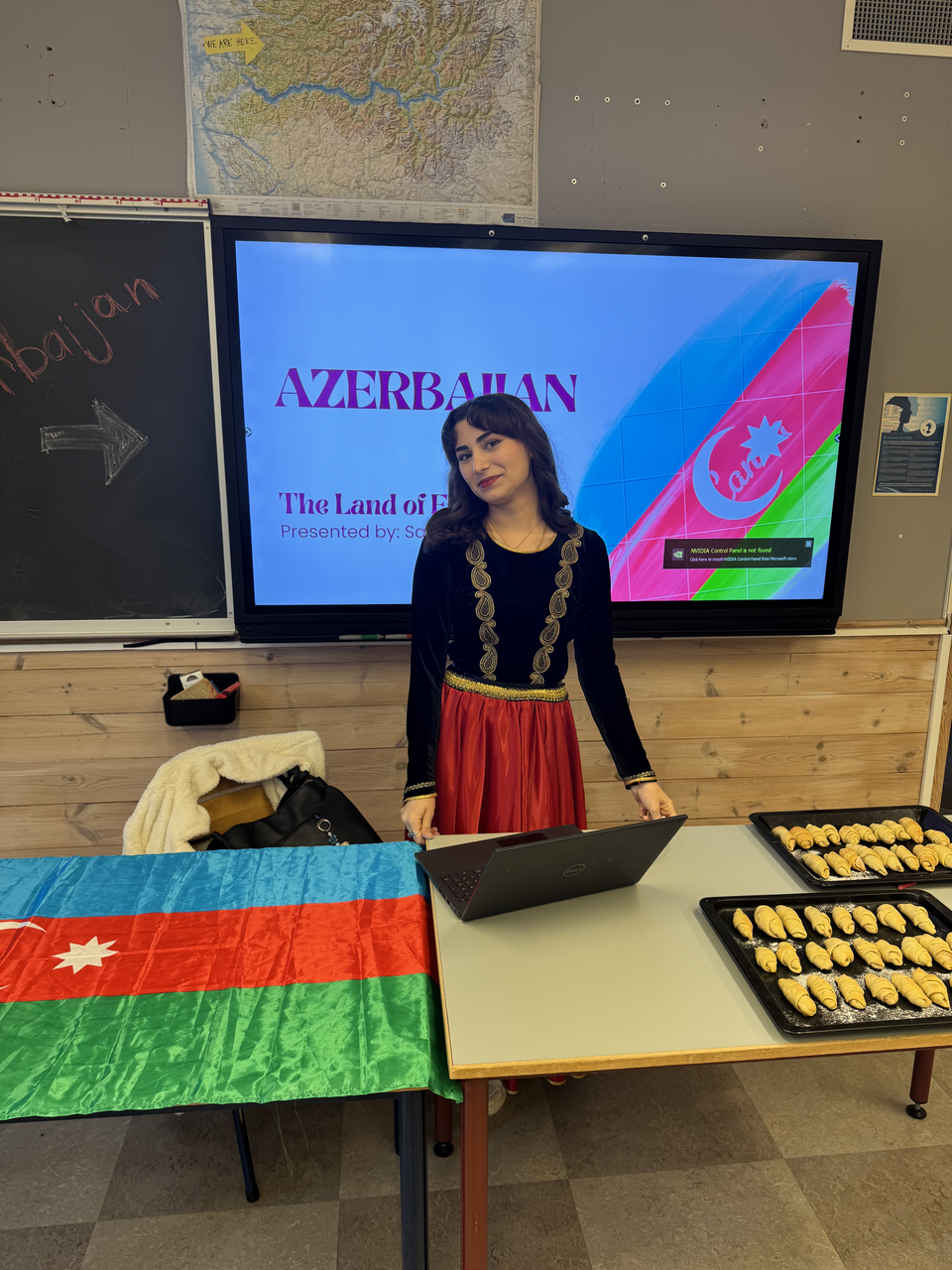
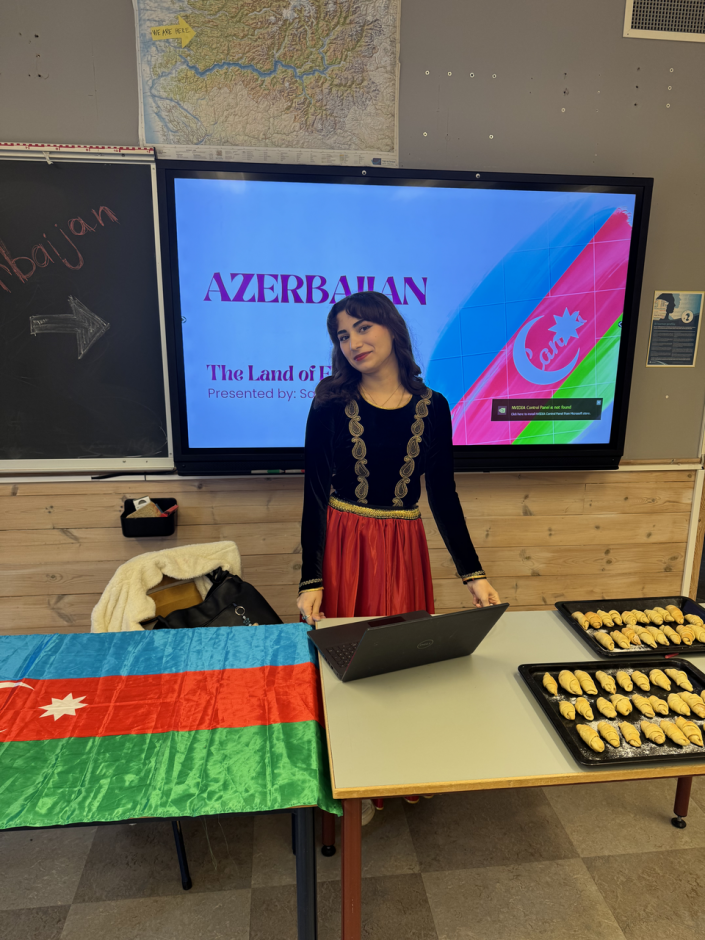
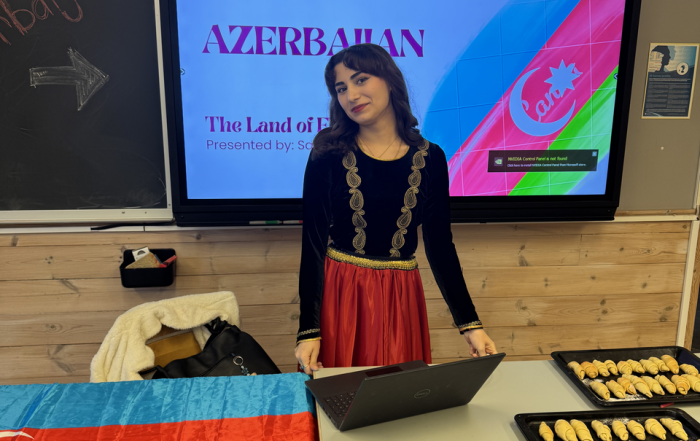
Today, we are thrilled to introduce Sabina Guliyeva from Azerbaijan, a UWC Red Cross Nordic alumna who is now studying computer science and generative AI at Vanderbilt University.

Sabina’s encounter with RCN began by serendipity. An admissions post on Instagram caught her eye just eight minutes before the application deadline, and a few months later, she started studying in Norway, becoming one of the second cohort of students admitted by her relatively new national committee which has been established in 2022.

“At that time, my national committee would get three to four spots a year, and we wouldn’t know which school would give us a spot. I didn’t even think about RCN when I was applying, and I told my friends that Norway would never, ever give us a spot. But here is what they did and I got there,” said Sabina, reminiscing about her application process, a trace of bubbling excitement still visible on her face.

For her, being the first ever Azerbaijani student at RCN means both challenges and growth.  

“When I first arrived, I did not have a second-year student and could not speak my language with anyone on campus. We had this book where you could sign your name, and the rector at the time was trying to find a previous person from my country. But  I told him, ‘ Do not try. There is no one there.’

“In a good way, it pushed me to be friends with more people outside of my culture and end up seeing the positive things about it . At the same time, it feels like that you are becoming the footprint for future students who will come to the school after you.”
As Sabina’s life in RCN gradually unfolded, she began to embrace the “utopian-like” experience and thrived on the picturesque campus dwelling beside the Nordic fjord.

“RCN is one of the places where you have the choice to actually launch so many things. Before I came here, I began getting interested in fashion in my second year.  So I talked to a few teachers in school and started a Project-Based Learning initiative, where we would design clothing with fabrics for the whole PBL time, whenever people wanted. 

“Seven or eight students were there and they really enjoyed it. We stayed until about six at night, just designing things solely because we wanted to. And school helped us find machines and materials. 


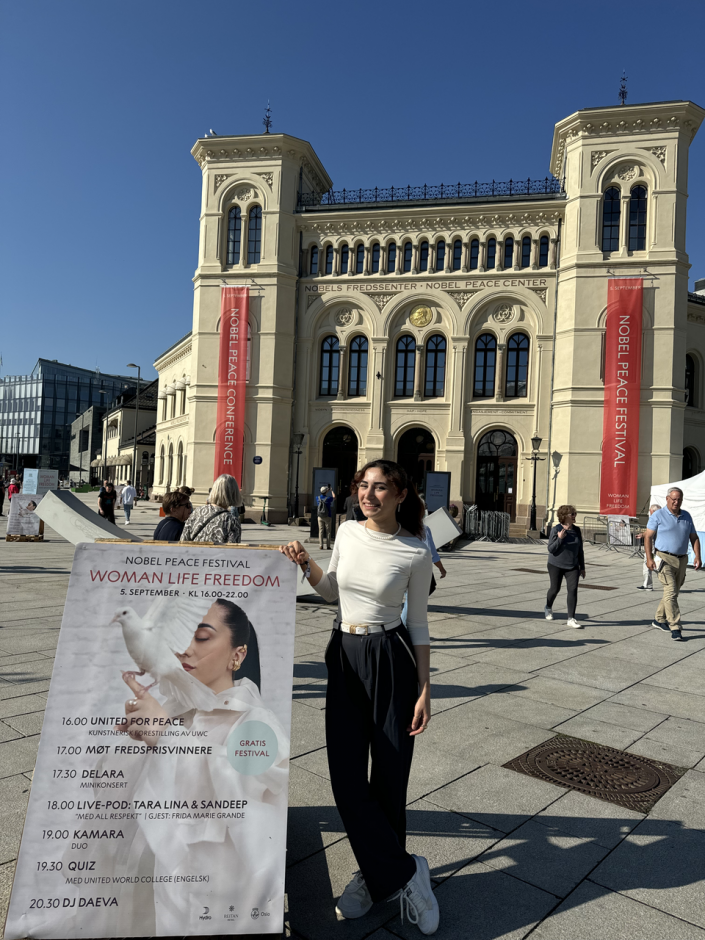
“And there are so many other things you could get involved with. For example, there is the second-year Oslo trip where we attend a news festival, and we also get to participate in the Nobel Peace Prize ceremony. None of the other UWCs do that.”

Such a multifaceted, rich life shapes Sabina into more than just a student. In her own words: “In the last two years, I have been studying, but at the same time I have never felt like a full-time student—neither at RCN nor at any time.”

This influence doesn’t fade after graduation; instead, it endures and follows her into the university life at Vanderbilt across the ocean.

“At this moment, there are many more things I’m working on. I’m having a startup with a friend in the U.S, and at the same time, there is my fashion life — I am going to attend some fashion shows at the end of this month. It is the intersection of these side projects that constructs my life piece by piece. And when I look back, this is very similar to how I did things at RCN.”
When asked what more she had learned from her time at RCN, Sabina reflected, “For me, the past two years have made me a person who could look at the world critically and see the positivity in the world, because it’s such a positive environment.”

“At UWC, everybody shares at least the same core beliefs or very similar ones, so you get used to people advocating for the change — in the world, in their small communities, or just within themselves. Then, by talking to as many people as possible and trying to learn from them, you not only want to become a smart and successful person, but also one who can actually make a difference in the world. 

“After UWC, I had this feeling that what I really want to do is to give back to my country in some way, even if I’m not physically there.”

Gradually turning her words into action, Sabina is enthusiastically planning on launching a “fashion-tech” project in Baku after she returns home in the upcoming August.

“While I was working in fashion, one thing I realized is that although Azerbaijan has a large consumer population for fashion, we do not have any fashion tech ecosystem. So when I go back there in August, I would like to talk to people who are based there and could help me to start a fashion shopping platform focused on sizing and AI molding, while incorporating fashion elements. So when people are buying clothing, they could use this platform to mathematically calculate their size and solve issues such as whether the clothes would fit correctly.”

All these cherished memories and lessons from RCN makes it especially hard for Sabina to say farewell. A year on, she could still freshly remember the very last day when she sat in the departure bus and uncontrollably cried, watching her friend leaving one by one.

“After living with people for two years, I got close to them and they are more than my family. You know that you will probably be back on this campus in ten years for a minimum time, but you never know when you’re going to see your friends again. 

“When you are still staying there at RCN, you would probably take so many things for granted. But I believe when you move out, you are gonna realize how much you will miss these years.”

In closing, no two RCN students share the same experience, yet there is always something that flows between us and keeps us connected — regardless of ethnicity, nationality and personality — such is what Sabina has said, explained and shared. It resonates with all of us, and will never fade away.

Written by Vivian Wu (RCN ’27) and Bekayim Duishenbieva (RCN ’27)
In People of UWCRCN you find stories of alumni or other members of our community. Here are the laterst.
Sabina Guliyeva RCN ’25

June 4th, 2026|

Today, we are thrilled to introduce Sabina Guliyeva from Azerbaijan, a UWC Red Cross Nordic alumna who is now studying computer science and generative AI at Vanderbilt University. Sabina’s [...]
Hamza Jalil Albasit, RCN’16

April 29th, 2025|

We’re proud to spotlight Hamza Jalil Albasit (RCN ’16) from Pakistan, whose debut novel, The Oracle of Hate, has just been published across South Asia. Set in the haunting [...]
Mark Chalkley, University Counsellor and more

2026-04-17T14:49:38+01:00April 17th, 2026|

Written by Vivian Wu (RCN ’27) and Bekayim Duishenbieva (RCN ’27)

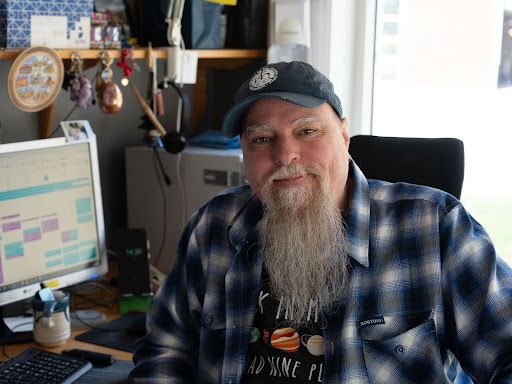
Today, we are excited to share the inspiring life story of Mark, who has worked in UWC Red Cross Nordic as a university counsellor for almost two decades since September 2006, meeting and helping thousands of students with passion, unique sense of humour, and all-time half-filled snack jars on the office table.

His first interaction with UWC RCN was for a visit to his friend in the latter half of 2005. The moment he landed, he instantly fell in love with this place. 

“When I arrived, the place looked spectacular,” said Mark, recalling the past. “I attended a ‘World Today’ event. Back then, they used to happen on Fridays in the auditorium, and they were much bigger events. We also used to get quite a few people from the local community. There was a human rights lawyer giving a talk about his work, which was interesting. When he opened the floor for questions, the level of thought behind the questions from the sixteen- and seventeen-year-olds blew my mind.”

“And I thought to myself—how can I become part of this?”

In mid-March 2006, Mark came to RCN again and stayed here for another couple of weeks, which then became the serendipitous beginning of the following twenty years of dedication.

“Back then, the bus timetable from Flekke to the boat had separate winter and summer schedules. It changed to the summer timetable on April 1st, and I didn’t know that, so I missed the bus. I ended up staying a few more days. While I was here, my friend suggested I make a list of all the jobs I’d ever done and see if maintenance could use me.”

Before that, Mark had done all kinds of jobs related to maintenance. He had been a postman, driving a heavy goods vehicle for the post office. He had operated heavy plant machinery, including but not limited to diggers, tractors and forklift trucks. He had also installed double glazed windows, built extensions to houses, and sold building supplies. 

“I wrote the list, and my friend gave it to the maintenance manager. At the time, the rektor, John Lawrenson, suggested I talk to his wife, Nicky, who worked in the university office. She asked me to come to the office at three thirty. We started talking and were still talking at five thirty. We got on well, and she seemed to like me. After that, there was a gap. I went home and didn’t hear anything until early August, when Nicky contacted me and asked me to send my CV. I had to write one, and then I didn’t hear anything for another two to three weeks.

“One day I got this weird conference phone call. It was John and Nicky and me on this call. And this is back when internet and video conferencing wasn’t really a thing. So it was still on my mobile, but there were three voices at the same time. And they were talking about when I could start and all this sort of stuff. They never said, ‘you’ve got the job.’ They just started talking about when I was going to come. Oh, it just started.”

At that time, Mark had been working as a bar manager in the UK for almost ten years. By luck, one month before he got the job offer, he decided to quit the position and instead stayed as a kitchen assistant, which made his resignation much easier. Additionally, his share options in the pub chain matured and so he sold them, which made him £1,000 and paid for the flights and accommodation on the way to Norway. 

“It was like everything fell into place,” Mark said, smiling as if still surprised by all these blessed coincidences.

With that reminiscing look in his eyes, he continued: “It was probably the best move I ever made. Some days, I find myself looking forward to coming to work, which not many people can say.”

When being asked about how it feels to be a university counselor, Mark joked that, “ I often feel that I have a parasitic relationship with the students, because working with you students gives me energy to keep connected. The last twenty years here, and ten years in the bars, has kept me, at least mentally, young. Like I said, you can’t avoid growing old, but you don’t need to grow up. I never really did. I think it’s the sort of energy and enthusiasm of the students and staff that you can leech off of. And it keeps me going.

“When I was working in the bar, I served somebody a beer, and they said, ‘thank you.’ But they were only saying thank you because it was kind of like the done thing. But when you guys say thank you, I know you mean it. Because it comes from the heart.”

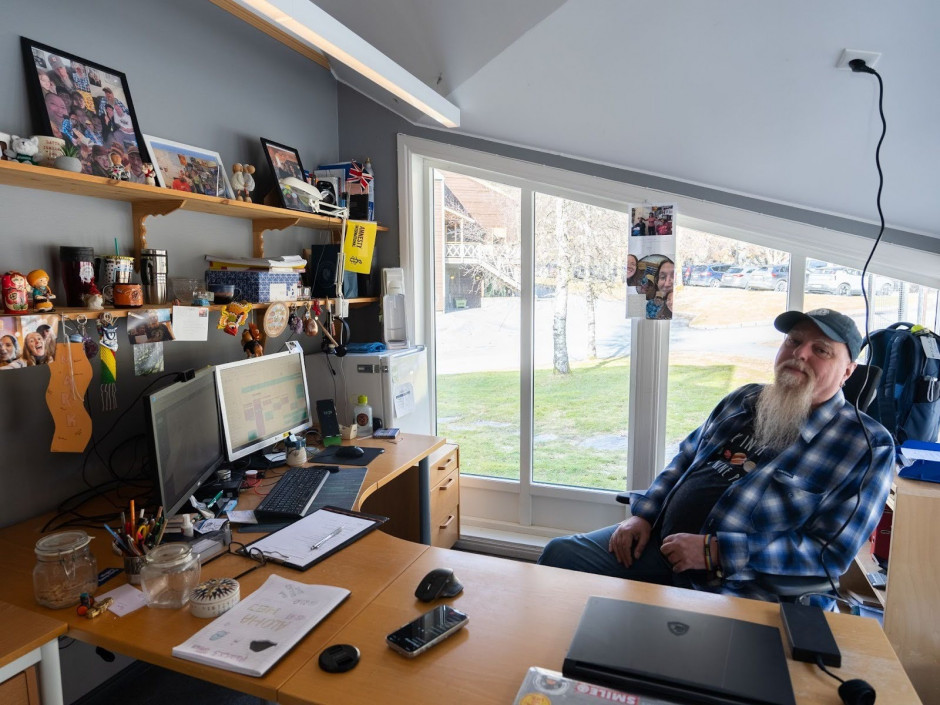
He then turned his swivel chair towards the nailed shelves on the wall, where he kept all the small items students have left over the years — they were tangible memories that witnessed the past old days and traces of existence for students who once thrived on this campus.

“I never forget a face, though I often forget names,” said Mark, who deals with sixty to eighty application cases every year. He could still immediately recall the story of the first student he had interaction with in 2005, and how he unfortunately retook the IB exams, unaware of the fact that he had already been admitted to a medical school in Denmark.

And sometimes such connection goes even deeper, which feels beyond student and teacher, but more like family and friends. 

“Two years ago, I had a Danish advisee. In Denmark, people have a tradition where, after you leave your last exam, you are presented with a captain’s hat from your parents. Her parents couldn’t make it, so she asked me to present her with the hat, and we did that. One day, she said to me that she sometimes feels closer to me, even more than she does to her parents.”

Another student, who graduated in 2020, still stays in touch and visits regularly. Their picture was pinned on the window frame right behind Mark’s seat, where he pointed while telling the story about how they supported each other after each experiencing the loss of their closest relatives. 

“This place has changed me. Completely. Utterly.” He ended the interview with these two firm, short words. Outside the heavy glass door of the university office, the waiting figures of two students were reflected on the pane, and it was time to move on, the past intersecting with the present.

As ending words, we want to express our genuine gratitude towards Mark’s years of dedication and encouragement. Thank you Mark!

In People of UWCRCN you find stories of alumni or other members of our community. Here are the laterst.

Sabina Guliyeva RCN ’25

June 4th, 2026|

Today, we are thrilled to introduce Sabina Guliyeva from Azerbaijan, a UWC Red Cross Nordic alumna who is now studying computer science and generative AI at Vanderbilt University. Sabina’s [...]

Hamza Jalil Albasit, RCN’16

April 29th, 2025|

We’re proud to spotlight Hamza Jalil Albasit (RCN ’16) from Pakistan, whose debut novel, The Oracle of Hate, has just been published across South Asia. Set in the haunting [...]
Hamza Jalil Albasit, RCN’16

2025-04-29T10:22:04+01:00April 29th, 2025|

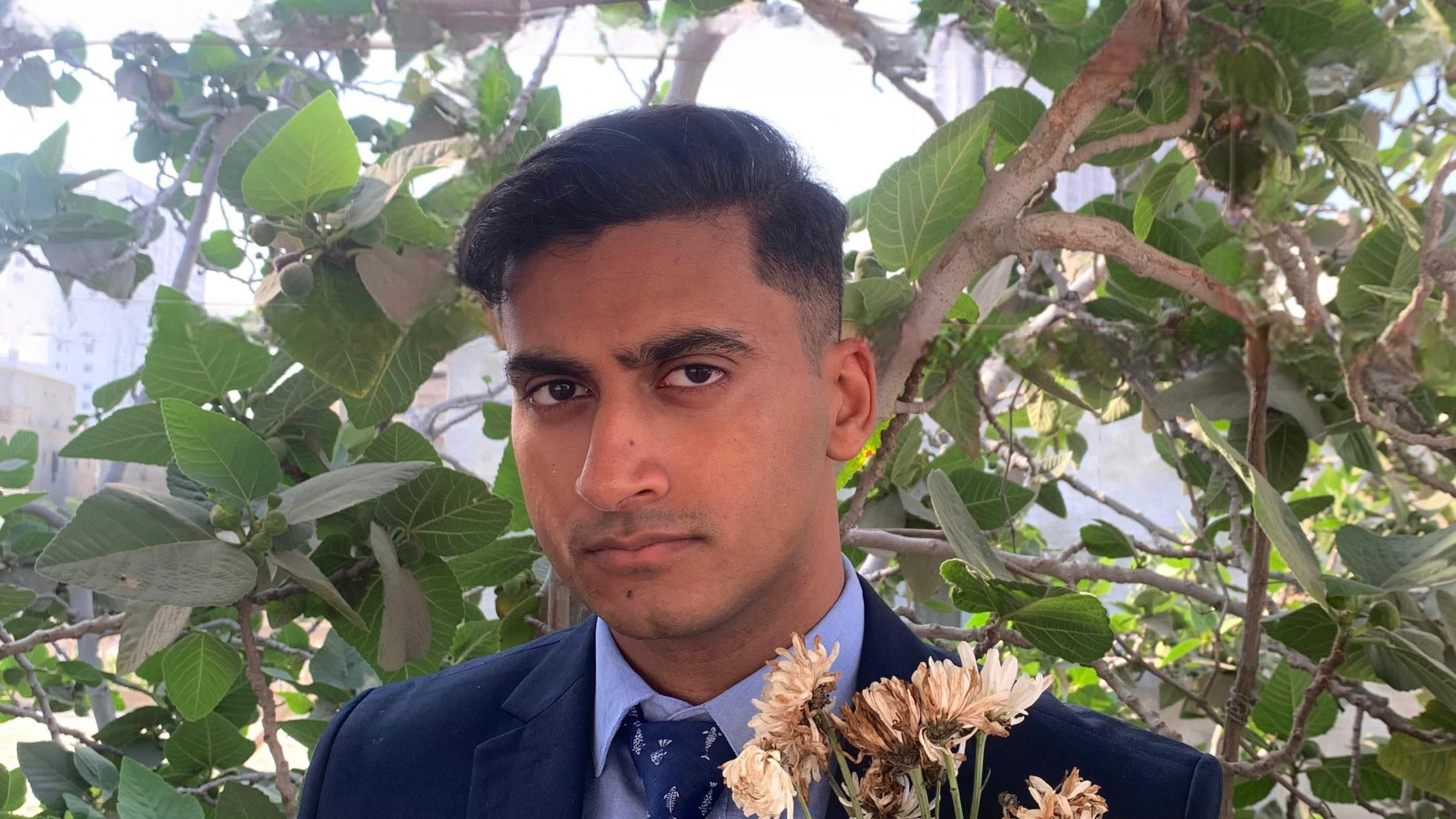
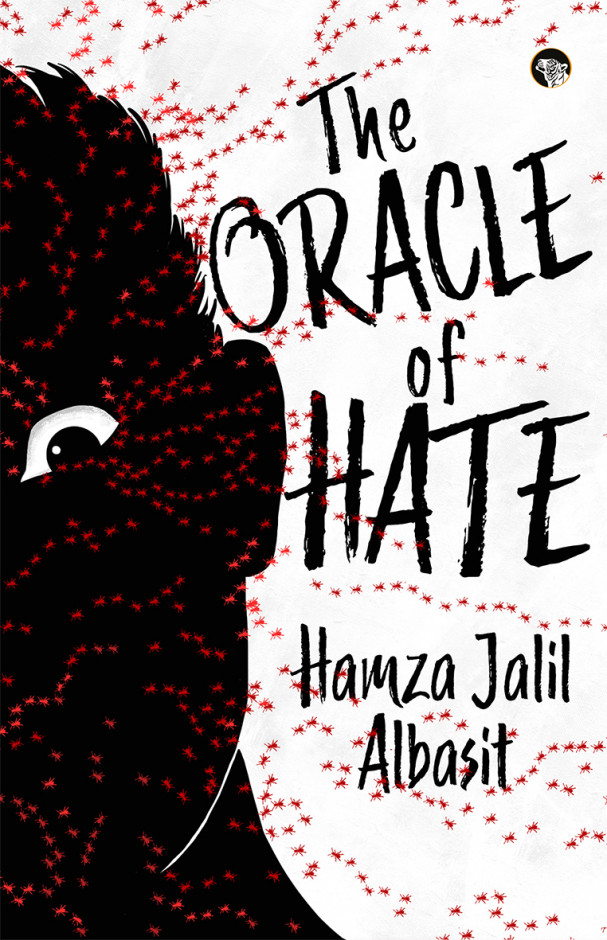
We’re proud to spotlight Hamza Jalil Albasit (RCN ’16) from Pakistan, whose debut novel, The Oracle of Hate, has just been published across South Asia. Set in the haunting underbelly of Karachi, the novel blends magical realism, political unrest, and generational trauma—a narrative Hamza calls “an ode to the city that both broke and built me.

Reflecting on his time at RCN, Hamza says, “I was a curious kid at RCN. Even though I was a science student—Physics and Chemistry HL—my heart was always drawn to the arts. I found refuge in theatre, both writing and directing, and led the Theatre EAC with my friends. The highlight of that time was our adaptation of Arthur Miller’s A View from the Bridge, which I directed with their support. RCN was where my passion for storytelling was not only validated, but nurtured. I was surrounded by great teachers—Peter Wilson, Mariano Giampietri, and Maria Teresa, to name a few—who mentored me throughout my journey at the college.

After graduating from RCN, Hamza pursued his undergraduate studies in the United States, where he continued to explore storytelling through film. He wrote and directed several short films under a student-led film company, often examining themes like the human condition, urban isolation and mental health on campus. Hamza began writing The Oracle of Hate in 2020, upon returning back to Pakistan. “I was completely lost. The country I grew up in, the language I once thought in, even the people around me—all of it felt foreign. I turned to stories, the only refuge I had. In the pages of García Márquez, Murakami, and Mohsin Hamid, I began to dream again.

It was a visit to his hometown, Karachi, that stirred something deeper.

Time had been unkind to my city. I saw it in the blood on the walls, in the horror people carried behind their eyes. And something in me shifted—not just nostalgia, but a deep sense of responsibility. I knew I had to write. Not to expla

in Karachi, but to listen to it. To let it speak through me.

The Oracle of Hate is a genre-blending literary fiction set in contemporary Karachi. It follo

ws Waleed, a young man whose life is upended after a violent mugging draws him into the city’s criminal and political underworld. As Karachi prepares for national elections, Waleed becomes entangled in a network of power, loyalty, and betrayal—forcing him to confront his family’s unraveling and his own haunted past. Exploring themes of memory, faith, and violence, the novel offers a powerful portrait of a city caught between myth and reality.
The novel is now available across South Asia. Hamza and his agent are currently working on a wider international release.

RCN gave me the freedom to explore stories that take risks. It taught me to value ambiguity, to sit with what’s unsaid, and to lean into complexity—all of which shaped the way I write. I remain grateful for how the college—and the UWC experience—helped shape my perspective and nurture my voice.

Building Bridges Through Experience: UWC Educators at RCN

2025-01-31T08:56:30+01:00January 31st, 2025|

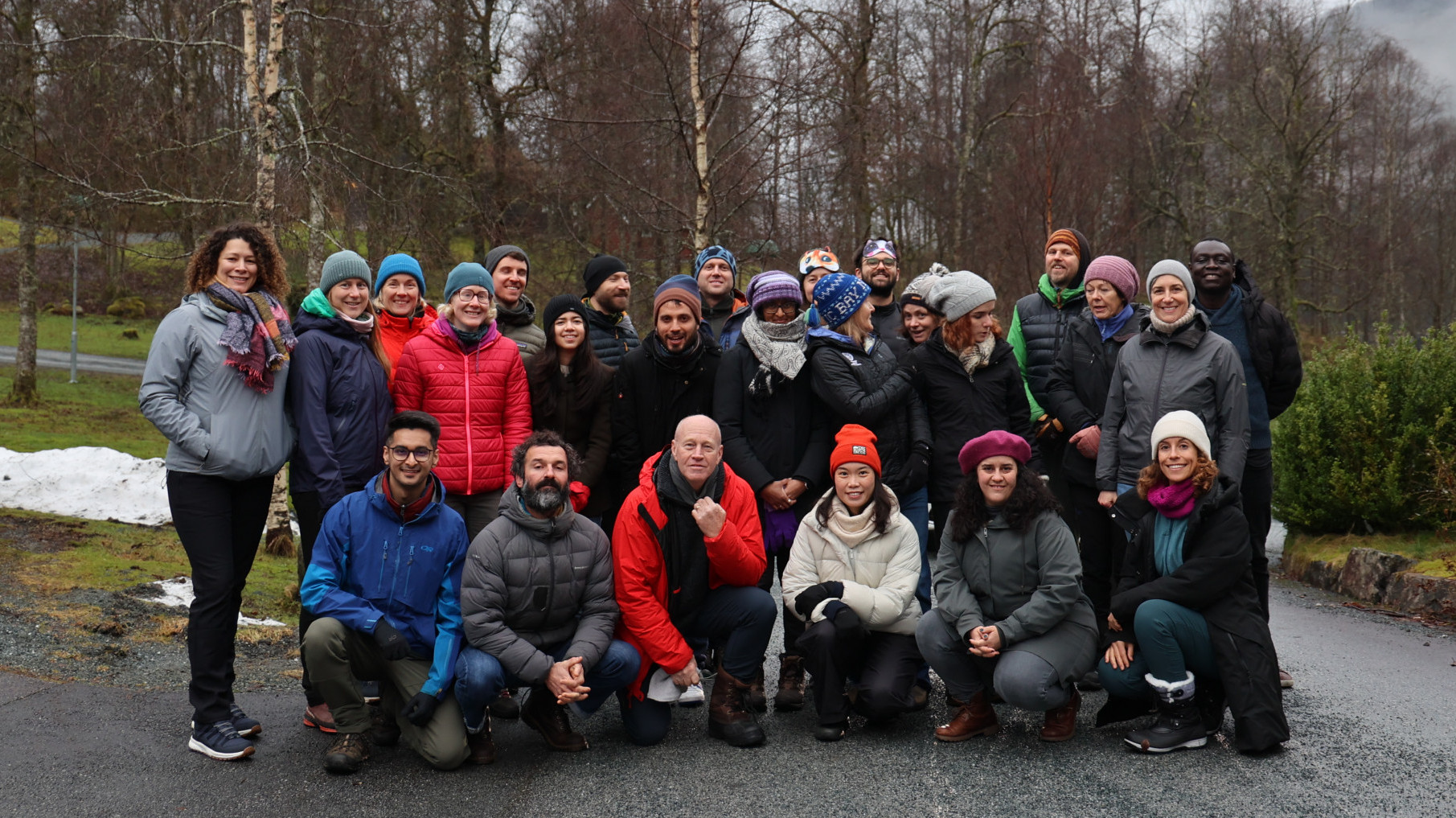
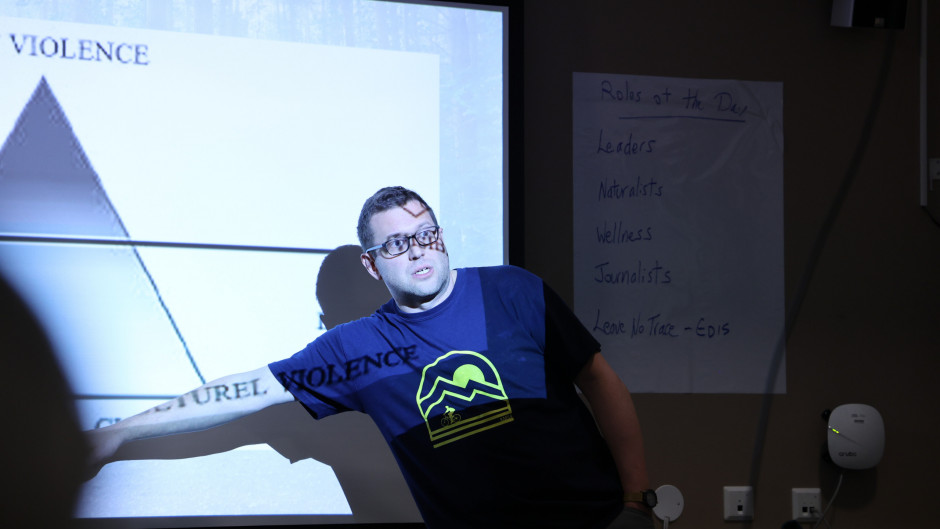
Between January 20th and 25th, 2025, UWC Red Cross Nordic, in collaboration with the Outward Bound Center for Peacebuilding, hosted an international professional development training course for UWC educators from across the movement. This initiative was inspired by the shared history and educational values of UWC and Outward Bound, both deeply committed to experiential learning and peacebuilding.

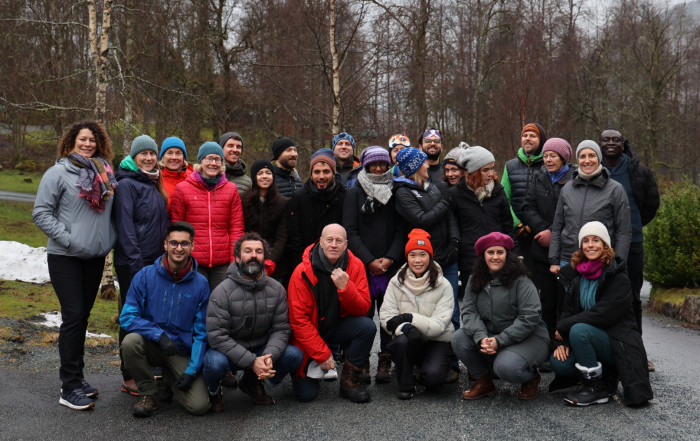
Educators from seven UWC schools—UWC Adriatic, UWC Robert Bosch College, UWC Changshu China, UWC Dilijan, Li Po Chun UWC of Hong Kong, UWC Mostar, and UWC Red Cross Nordic—joined the training, alongside representatives from UWC International and the affiliated organization Seeds of Peace. The trainer team brought expertise from The Outward Bound Center for Peacebuilding, Outward Bound International, and Penn State University.

This unique training focused on Experiential Peacebuilding, a methodology that aligns with the UWC mission and fosters community-building, trust, and conflict resolution. As the kick-off event for UWC RCN’s 30th anniversary celebrations, this training set the stage for a year of meaningful initiatives. Looking ahead, we hope to establish this as an annual event, continuing to equip educators with practical tools to integrate peacebuilding practices into their daily work.

At the heart of Experiential Peacebuilding lies the belief that peace is built from the inside out and from the bottom up. Participants explored peacebuilding through four interconnected relationships:

  • The Self
  • Self & Others
  • Self & Community
  • Self & Nature/Environment

Through theory, interactive exercises, and outdoor challenges, the course provided an immersive experience that placed participants in the role of both learner and leader.

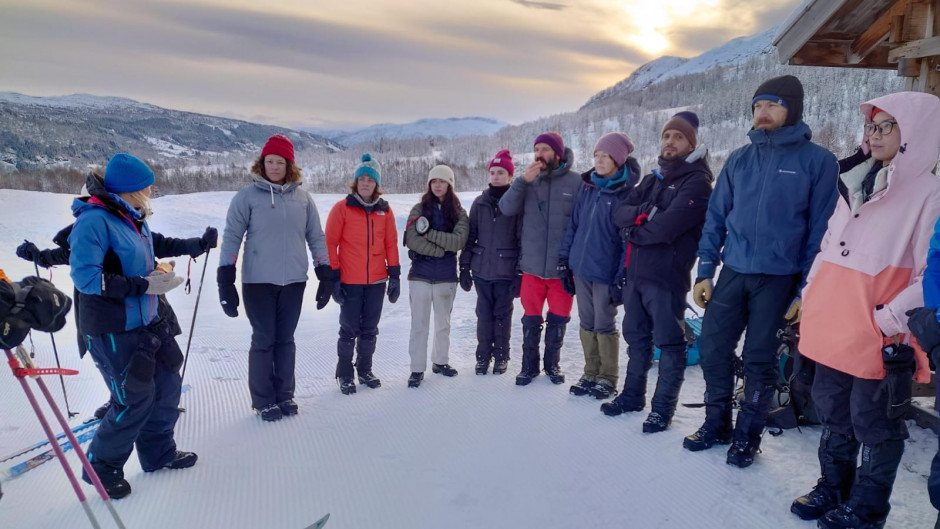
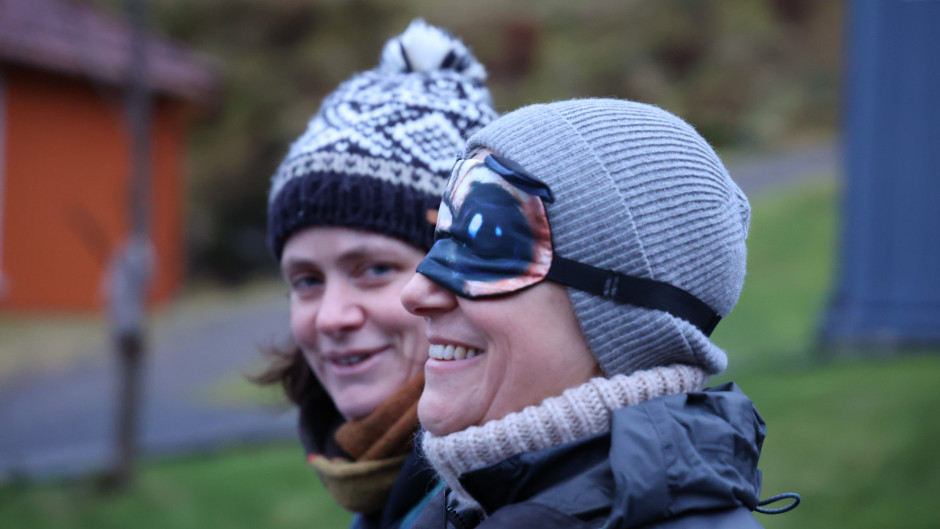
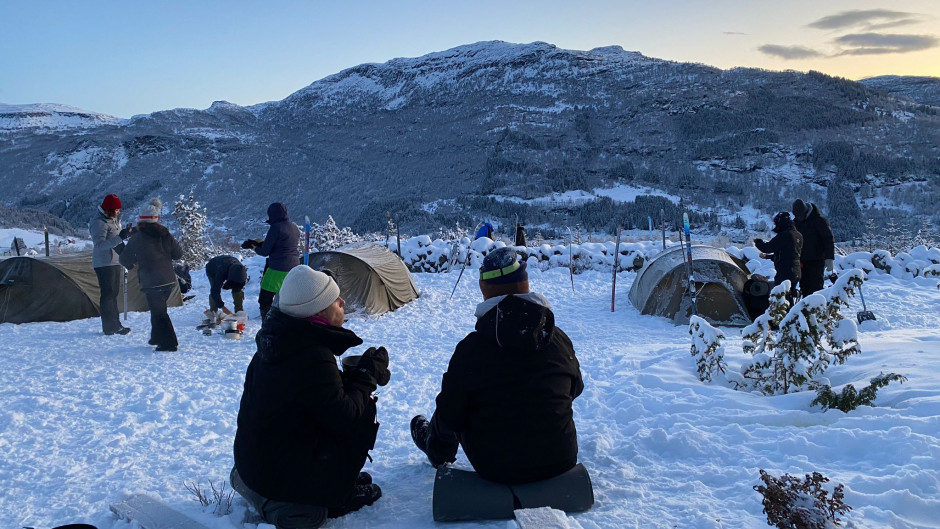
The first two days were dedicated to peacebuilding and experiential learning theories, explored through engaging, hands-on activities. Then, on the second evening, the group prepared for an overnight winter expedition in Sogndal. For many, cross-country skiing and camping in sub-zero temperatures was an entirely new challenge—pushing comfort zones, strengthening trust, and forging deep connections. By the time they returned to campus on Day 4, the participants had not only gained unforgettable experiences but had also built strong bonds with their peers.

The final two days focused on reflection and application. Participants analyzed their experiences, connected theories to real-world contexts, and planned how to bring Experiential Peacebuilding into their schools and communities. The closing session fostered collaborative discussions on future initiatives and next steps, ensuring that the impact of the training would extend far beyond the week itself.

With this training, UWC RCN continues to champion education as a force for peace, empowering educators to cultivate stronger, more connected communities—one experience at a time. We look forward to seeing this initiative grow and inspire future generations of UWC educators.

Latest News

Sabina Guliyeva RCN ’25

June 4th, 2026|

Today, we are thrilled to introduce Sabina Guliyeva from Azerbaijan, a UWC Red Cross Nordic alumna who is now studying computer science and generative AI at Vanderbilt University. Sabina’s encounter with RCN began by [...]

Go to Top